What is fitness age?
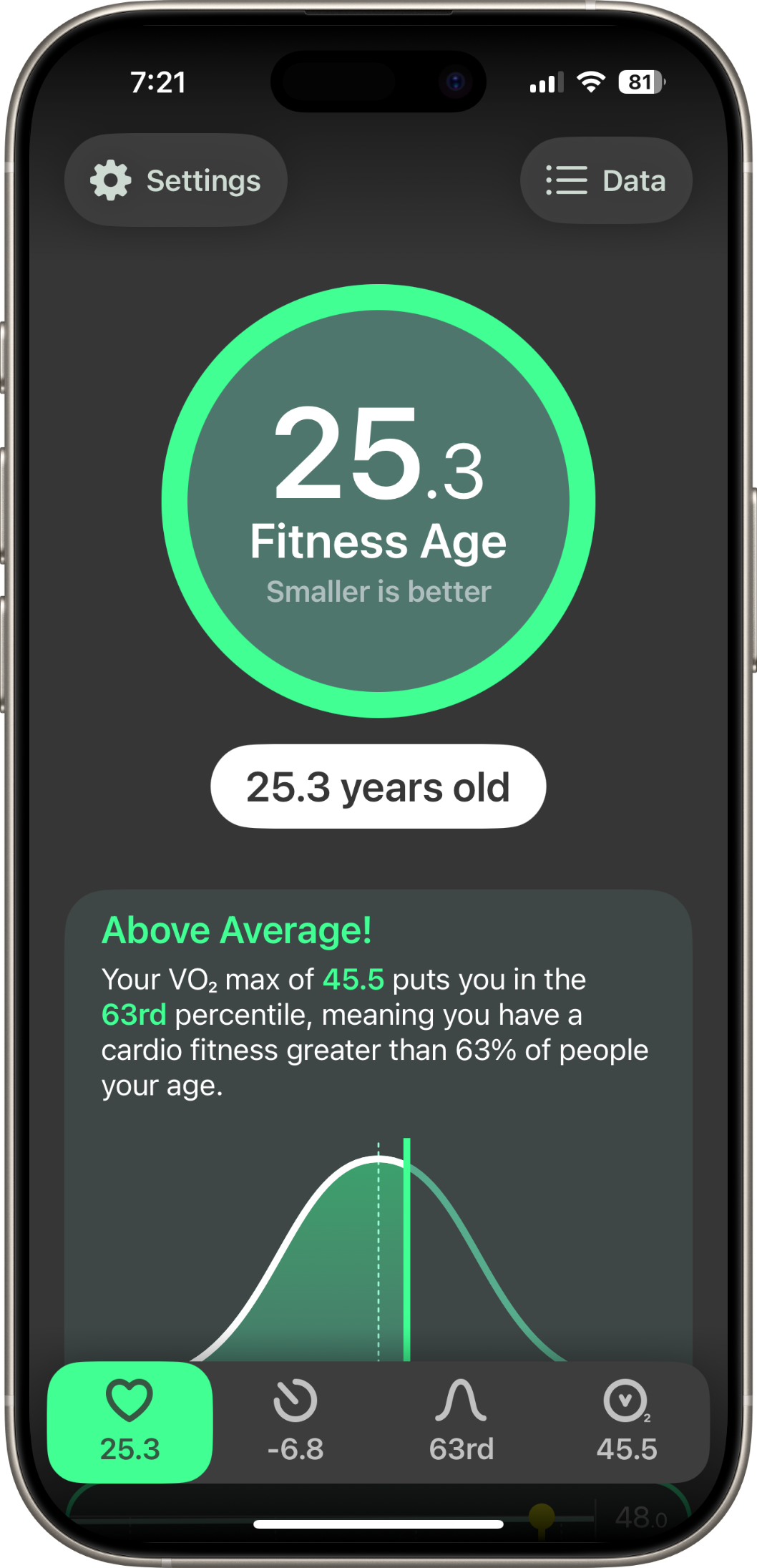
Fitness age is an estimate of your body's cardiovascular health expressed as an age. A 45-year-old with excellent cardio fitness might have a fitness age of 30, while a sedentary 30-year-old could have a fitness age of 45. It's a simple, intuitive way to understand how fit you really are relative to the general population.
The concept was popularised by researchers at the Norwegian University of Science and Technology (NTNU), who found that cardiorespiratory fitness — specifically your VO₂ max — is one of the single strongest predictors of long-term health and mortality.
The key metric: VO₂ max
At the heart of every fitness age calculation is VO₂ max — the maximum amount of oxygen your body can use during intense exercise, measured in millilitres per kilogram of body weight per minute (ml/kg/min).
A higher VO₂ max means your heart, lungs, and muscles are more efficient at delivering and using oxygen. It's considered the gold standard measure of aerobic fitness.
But what does a given VO₂ max actually mean? The chart below shows how VO₂ max maps to percentile for a typical 40-year-old male. A higher VO₂ max puts you further to the right on the curve — meaning you're fitter than a larger percentage of people your age.
These ranges shift with age and biological sex, which is why a raw number alone doesn't tell the full story — and why fitness age is so useful as a way to contextualise the number.
How fitness age is calculated
The calculation works by comparing your VO₂ max to population reference data, adjusted for your age and biological sex. The steps are:
Done in a lab, estimated from a fitness test, or recorded automatically by your Apple Watch during outdoor walks, runs, and hikes.
Your VO₂ max is compared against normative data from large-scale studies like the FRIEND study, adjusted for age and sex.
The age at which your VO₂ max would be considered average becomes your fitness age. A value matching a 30-year-old's average when you're 42 means a fitness age of 30.
Relative age and percentile
Fitness age is just one way to interpret your VO₂ max. Two other useful metrics are:
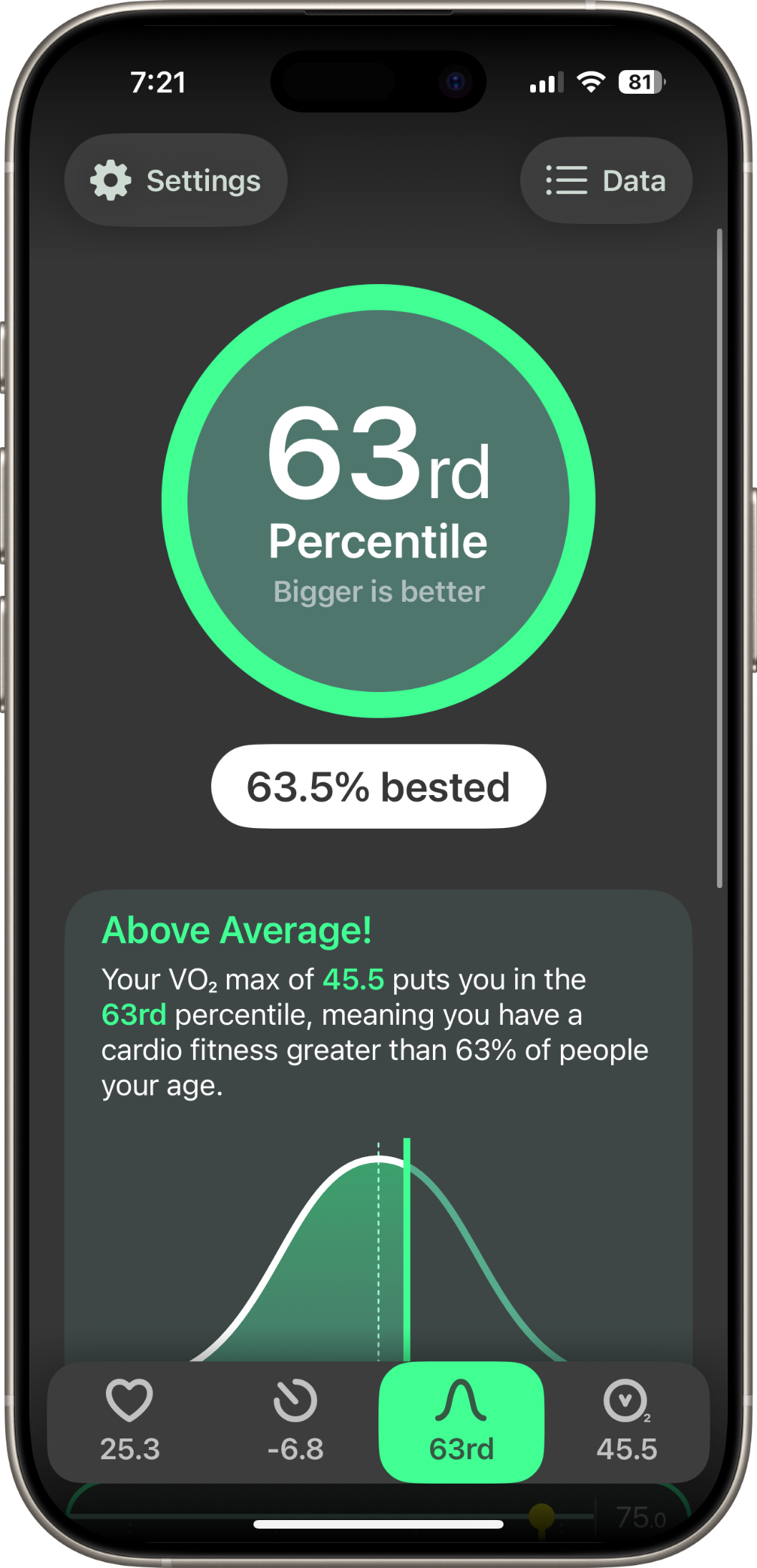
Relative age is the difference between your fitness age and your actual age. If you're 42 with a fitness age of 30, your relative age is -12 — meaning your cardiovascular system is performing like someone 12 years younger. Because it's age-adjusted, relative age stays stable over time and is a good way to track long-term changes.
Percentile compares your fitness level to people your own age. A 63rd percentile means your cardio fitness is better than 63% of people in your age group. It's a straightforward way to see where you stand among your peers.
Getting your VO₂ max from Apple Watch
If you have an Apple Watch (Series 3 or later), you don't need a lab test. The watch estimates your VO₂ max by analysing your heart rate and movement during outdoor walks, runs, and hikes, then writes the result to the Apple Health app as "Cardio Fitness".
To make sure it's working:
- Open the Health app on your iPhone
- Tap Browse → Heart → Cardio Fitness
- Make sure your age, sex, height, and weight are set in your Health profile
- Do regular outdoor workouts — the watch needs consistent data to produce estimates
Once you have Cardio Fitness data in Apple Health, you can convert it to a fitness age.
The easy way: let the app do it
You could look up conversion tables, cross-reference studies, and do the maths yourself — or you could let an app handle it automatically.

Fitness Age
Automatically calculates your fitness age, relative age, and percentile from your Apple Health data. Track your progress over time with interactive charts. Free on the App Store.
Download on the App StoreWhy fitness age matters
Research consistently shows that cardiorespiratory fitness is a powerful predictor of health outcomes — in some studies, more predictive than traditional risk factors like smoking, high blood pressure, or high cholesterol.
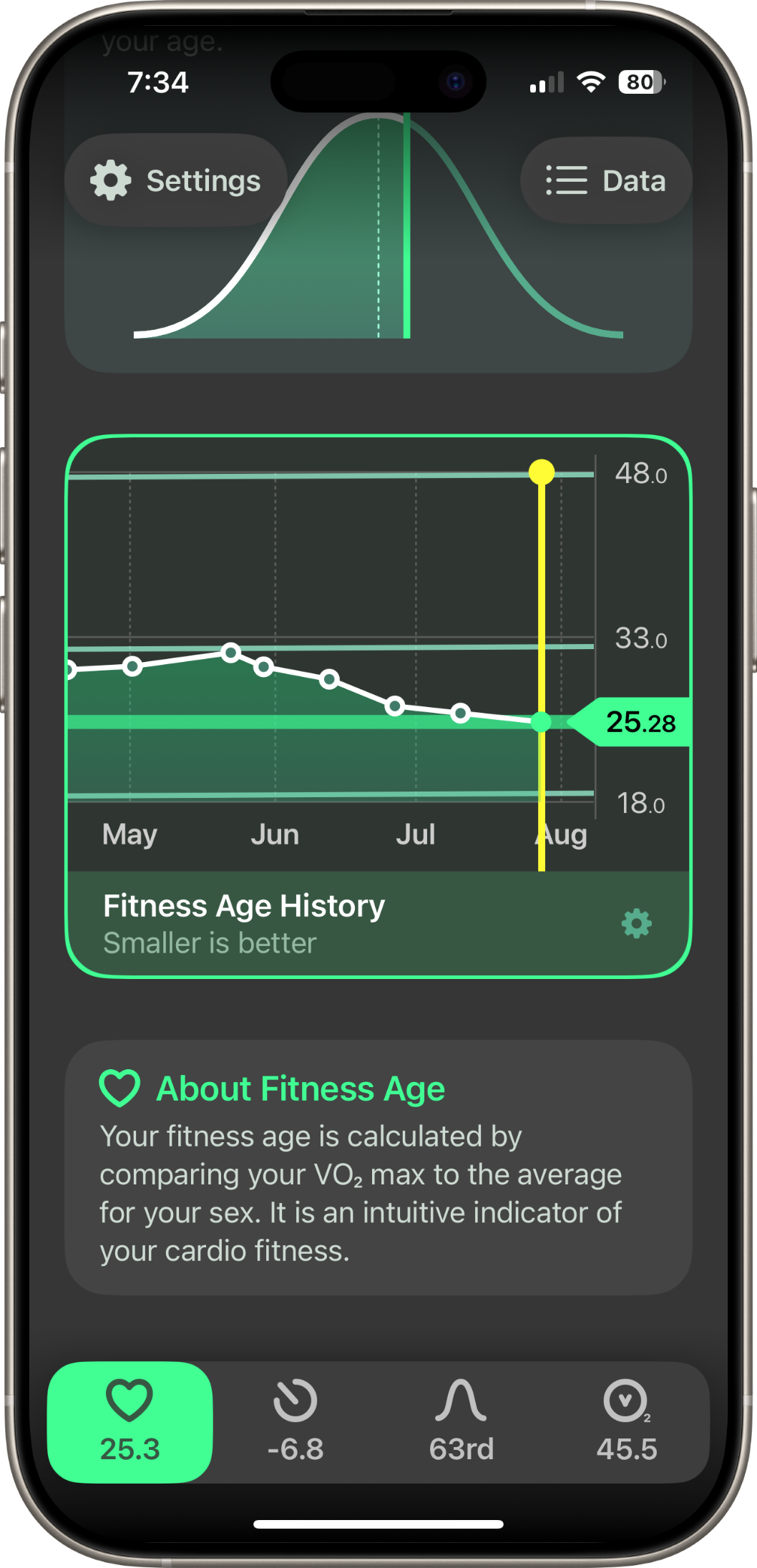
The good news is that VO₂ max responds to training at any age. Regular aerobic exercise — even brisk walking — can improve your fitness age over time. Tracking it gives you a tangible, motivating target.
A lower fitness age isn't just a number. It's associated with:
- Reduced risk of cardiovascular disease
- Lower all-cause mortality
- Better metabolic health
- Improved cognitive function as you age
Start tracking your fitness age
If you've got an Apple Watch and an iPhone, you already have everything you need. Your watch is recording your VO₂ max in the background — all that's left is turning that number into something meaningful.
Download Fitness Age from the App Store and see where you stand.